Red Balkenkreuze?
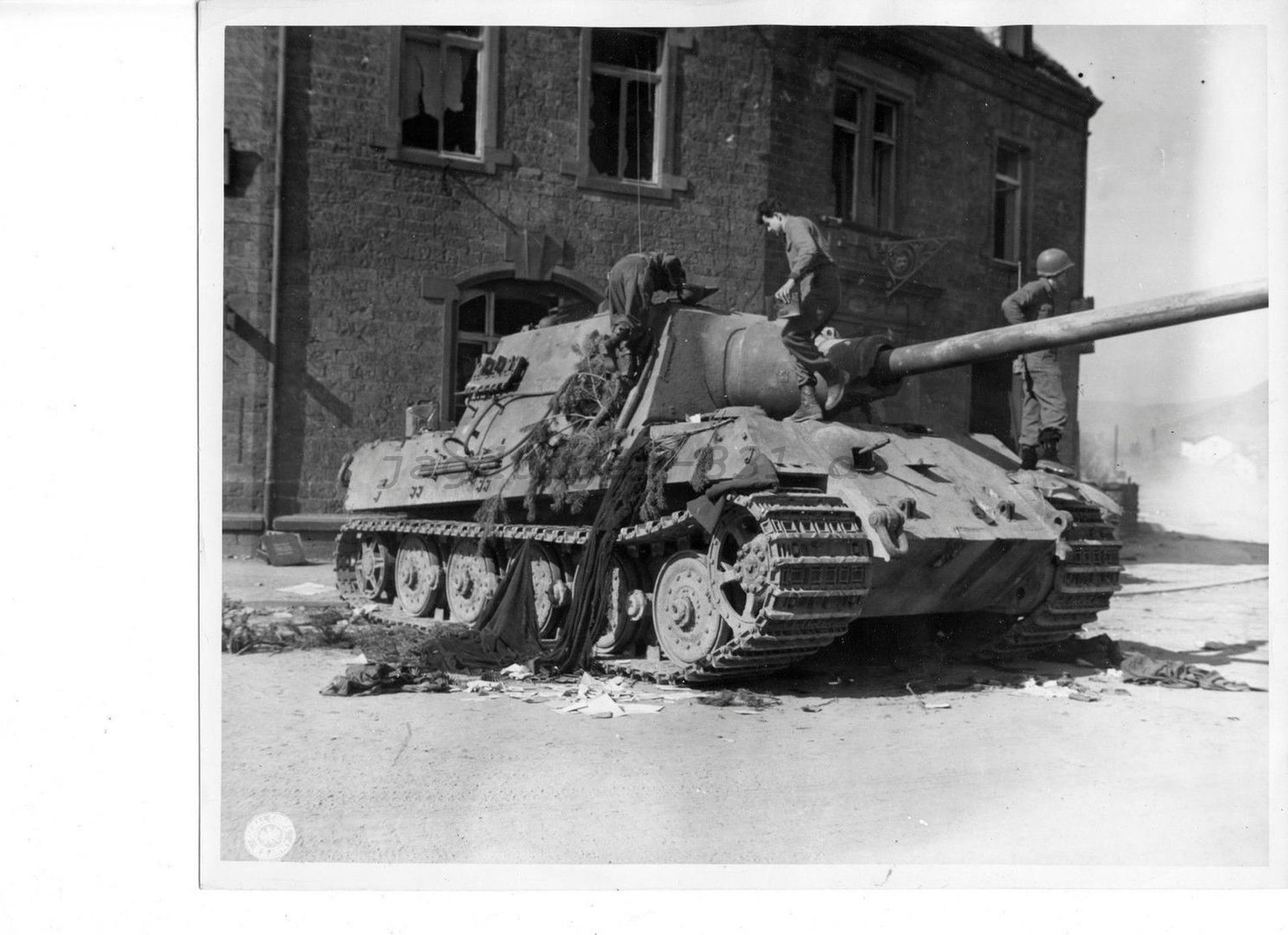
What colors were used for the Balkenkreuze on Jagdtiger 331? Period photographs, a surviving assault gun and an August 1944 order provide important clues, but not yet a definitive answer for this particular vehicle.
What Do the Original Photographs Show?
Many models of Jagdtiger 331 depict red Balkenkreuze. In period black-and-white photographs the markings appear very dark. This initially suggested camouflage paint, grey or black. The drawings in Devey's book “Jagdtiger” also refer to black crosses.
A Surviving StuG III G
A surviving StuG III G in the Fort Benning collection shows a Balkenkreuz with red outer corner markings at the rear. Its reportedly surviving 1944 paintwork provides physical evidence that red elements were used on some wartime crosses.
Video evidence: Hilary Doyle, NACC Fort Benning. The relevant segment begins at approximately 8:40.
External YouTube video; playing it may transmit data to the provider.
The Order of 18 August 1944
A Danish colleague drew attention to an order issued by the Inspector General of Armoured Troops. The order refers to frontline experience and a demonstration on 16 August 1944 at Wa Prüf 6 in Kummersdorf. It describes the markings of tanks and armoured vehicles.
Excerpt concerning the design of the Balkenkreuz:
“Black centre (as before), red outlines (at the corners) instead of the previous white.”
Source: Bundesarchiv, BArch NS 33/148, page 23. The complete text can be found in the original document.
An order dated August 18, 1944 specified a black center and red corner outlines instead of white. It referred to tanks, armored reconnaissance vehicles and assault guns; the precise application to Jagdtiger 331 requires further examination.

Original document excerpt: Bundesarchiv, BArch NS 33/148, p. 23. Click to enlarge.
English translation of the Bundesarchiv document
Order of 18 August 1944
The Inspector General of Armoured Troops
Army High Command (OKH), 18 August 1944
Subject: Balkenkreuze and Tactical Numbers on Tanks and Armoured Vehicles
To: Special Distribution List
Based on experience gained at the front and a proposal made on 16 August 1944 during a meeting at the Führer's Headquarters, the Inspector General of Armoured Troops orders the following concerning the application of Balkenkreuze and tactical numbers to tanks and armoured vehicles:
1. Balkenkreuze (National Identification Crosses)
The Balkenkreuze are to be retained on tanks, armoured reconnaissance vehicles and assault guns.
They are to be omitted from all other armoured vehicles.
Design: The central area is to be black (as previously), while the outlining angles at the corners are to be red (instead of the previous white).
2. Tactical Numbers
Tactical numbers are to be retained as previously.
Design:
- I. Battalion (1st Battalion): Red numbers with a 5 mm wide white outline.
- II. Battalion (2nd Battalion): Yellow numbers without an outline.
3. Numbering Within Units
a) The method of numbering is left to the discretion of the individual armoured formations.
It is to be ordered within the regiment or battalion and reported to the division for notification of the other troop units.
b) The purpose of the numbering system is to facilitate command and control during combat.
It must be designed in such a way that anyone can recognise the organisational structure without the enemy being able to draw conclusions about that structure.
The numbers 0 and 1 are, in our experience, unsuitable for command vehicles.
The Chief of Staff
Signed: Thomale
Forwarding by the SS Main Office
SS-Führungshauptamt
Office II
Berlin-Wilmersdorf, 28 August 1944
Kaiserallee 188
Reference No.: II/12350/44 geh.
Subject: Balkenkreuze and Tactical Numbers on Tanks and Armoured Vehicles
To: Special Distribution List
Enclosed is a directive issued by the Inspector General of Armoured Troops concerning “Balkenkreuze and Tactical Numbers on Tanks and Armoured Vehicles”, forwarded for information.
By order,
Signed: Maier
SS-Obersturmbannführer
What Does This Mean for Jagdtiger 331?
The surviving paintwork on the assault gun and the order make red corner markings historically plausible. However, these two pieces of evidence alone cannot conclusively establish whether the directive was applied to tank destroyers in the same way or whether Jagdtiger 331 actually carried such a cross. The 3rd Company of Heavy Tank Destroyer Battalion 653 was subordinated to the 17th SS Panzergrenadier Division. Further photographs of vehicles assigned to that division may therefore exist and could provide additional clues about the appearance of their Balkenkreuze.
Documented: an August 1944 order specified red corner outlines, and red elements are visible on a surviving StuG III G. Unresolved: the exact markings carried by Jagdtiger 331.
Sources
Bundesarchiv: BArch NS 33/148, p. 23 · Devey: “Jagdtiger” · Video featuring Hilary Doyle on the StuG III G at Fort Benning.