The History of Jagdtiger 331 · 1944–1945
A chronological reconstruction of the history of Jagdtiger 331 – from its manufacture at the Nibelungenwerke and service with Heavy Anti-Tank Battalion 653 to its abandonment in Neustadt an der Weinstraße in March 1945.
Note
Certain events, particularly the precise causes of damage and the number of tank losses, are based on historical reconstructions or conflicting reports and have not been conclusively established.
Operational History of Heavy Anti-Tank Battalion 653
This chronology focuses on Jagdtiger 331. The complete operational history of the battalion is considerably more extensive.
Production
Jagdtiger 331, chassis number 305020, is manufactured at the Nibelungenwerke.
Döllersheim and Unit Assignment
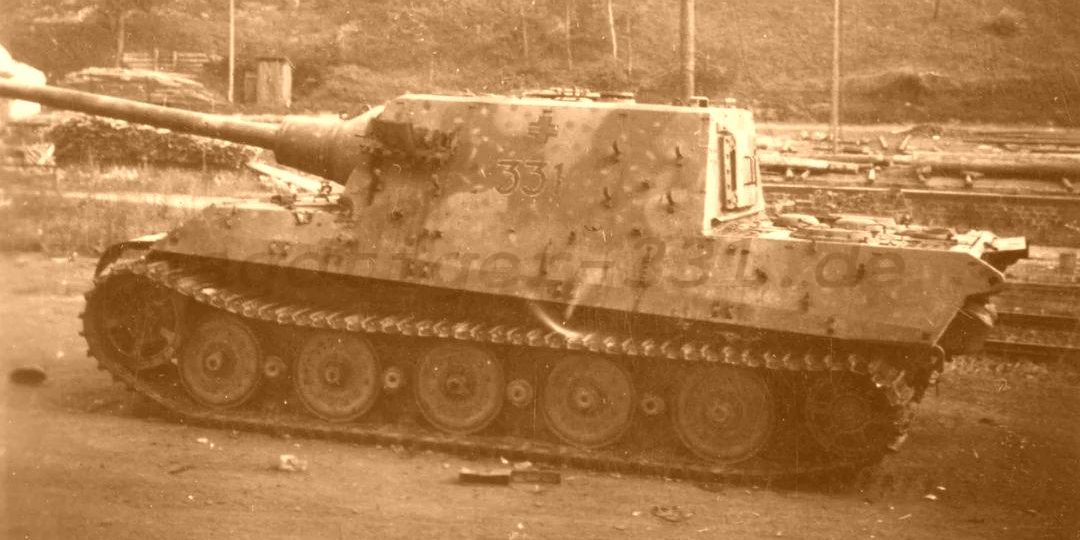
The vehicle arrives in Döllersheim and is assigned to the 3rd Company of Heavy Anti-Tank Battalion 653 on 24 November. It receives tactical number 331, with Lieutenant Kaspar Göggerle as commander. Very little is known about Göggerle. On 10 May 1943, as a reserve lieutenant in Anti-Tank Battalion 27, he was awarded the German Cross in Gold.
Rail Loading at Göpfritz
Loading onto railway wagons at Göpfritz for transfer to Wengerohr/Flußbach.
Rail Transport Delay
The rail transport is delayed in the tunnel near St. Goar.
Probable Arrival
Probable arrival in the Wengerohr/Flußbach area.
Rhine Crossing near Offendorf
The Rhine is crossed near Offendorf at 01:00.
Battalion Strength
According to a report, the battalion has 41 Jagdtigers: 22 operational and 19 requiring repairs. The assembly area is near Landau, where 331 is also located.
Rail Loading
Loading onto railway wagons once again.
Landau Area
On 5 February, arrival by rail at Rohrbach near Herxheim. The 1st Company is near Rohrbach and the 2nd Company near Herxheim. On 8 February, 32 Jagdtigers are reported in the Landau area.
Transfer to the Haguenau Forest
On 17 February, the battalion is transferred south to the Haguenau Forest/Wissembourg area. Unloading takes place at Surbourg on 19 February. In the final week of February, the 3rd Company is transferred by rail to the northern Haguenau Forest; the workshop company is stationed near Bellheim.
Fighting along the Moder
Following the breakthrough of the Moder line, the 3rd Company launches a counterattack. According to a report, five Jagdtigers are damaged by rockets and two by artillery near Morsbronn; five vehicles are demolished.
Rhine Crossing near Speyer
Elements of Heavy Anti-Tank Battalion 653 cross the Rhine near Speyer.
Advance on Neustadt
On 20 March, Task Force Cherry of the US 10th Armored Division reaches Lambrecht, west of Neustadt. On 22 March, the advance on Neustadt begins at approximately 01:11; at around 07:00 the troops encounter a roadblock at the western entrance to the town.
Fighting in Neustadt
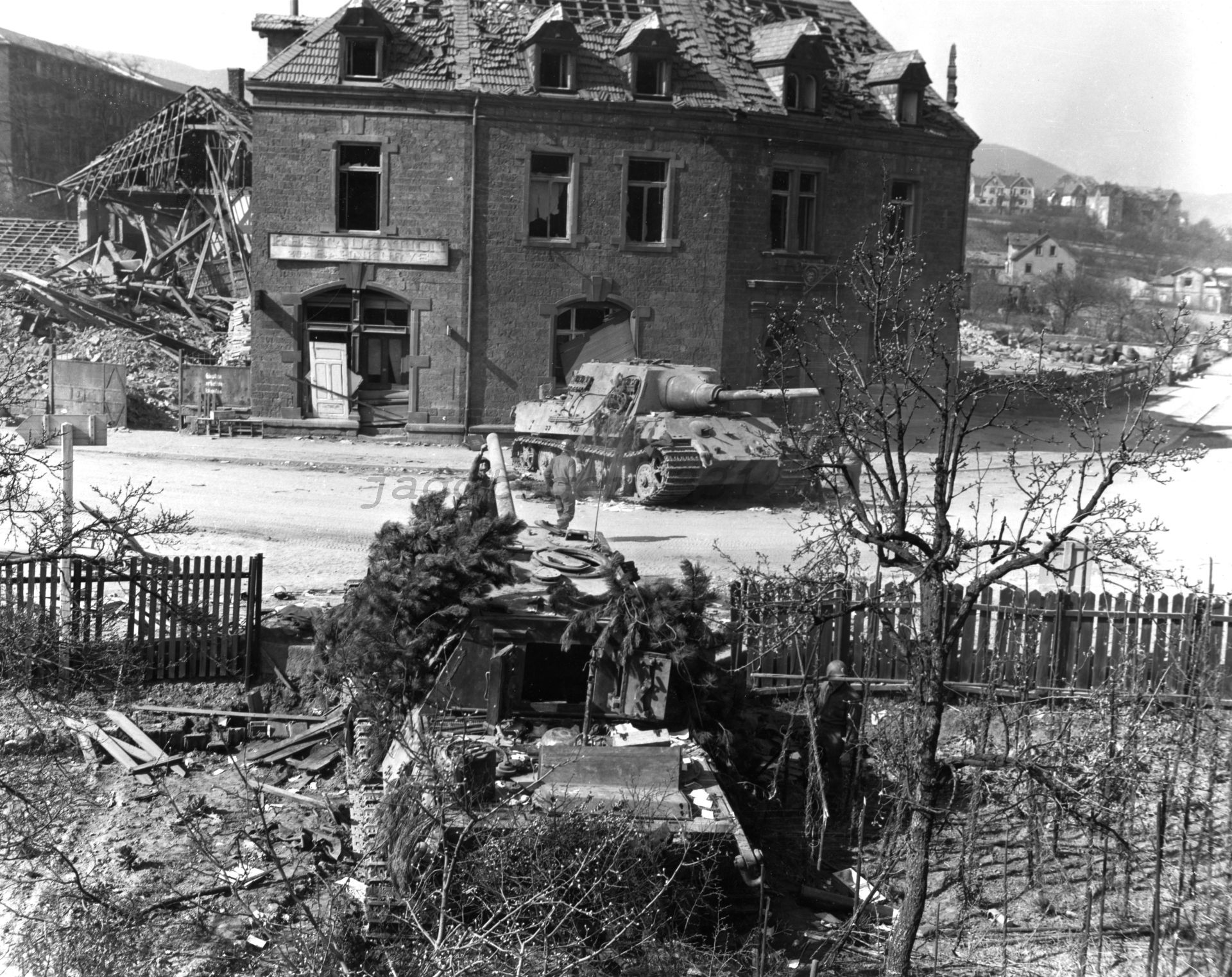
Lieutenant Göggerle, commanding 331, leads the third battle group of the 3rd Company, comprising six Jagdtigers. A battery of heavy 8.8 cm anti-aircraft guns is also stationed on the outskirts. Three Jagdtigers take up positions north of the town and engage an American armored column. M4 Shermans and M10s return fire; according to the reconstruction, 331 and 323 receive ten hits in total. Both vehicles withdraw into Landauer Straße: 331 stops outside number 70, while 323 enters a garden opposite.
Damage and Abandonment
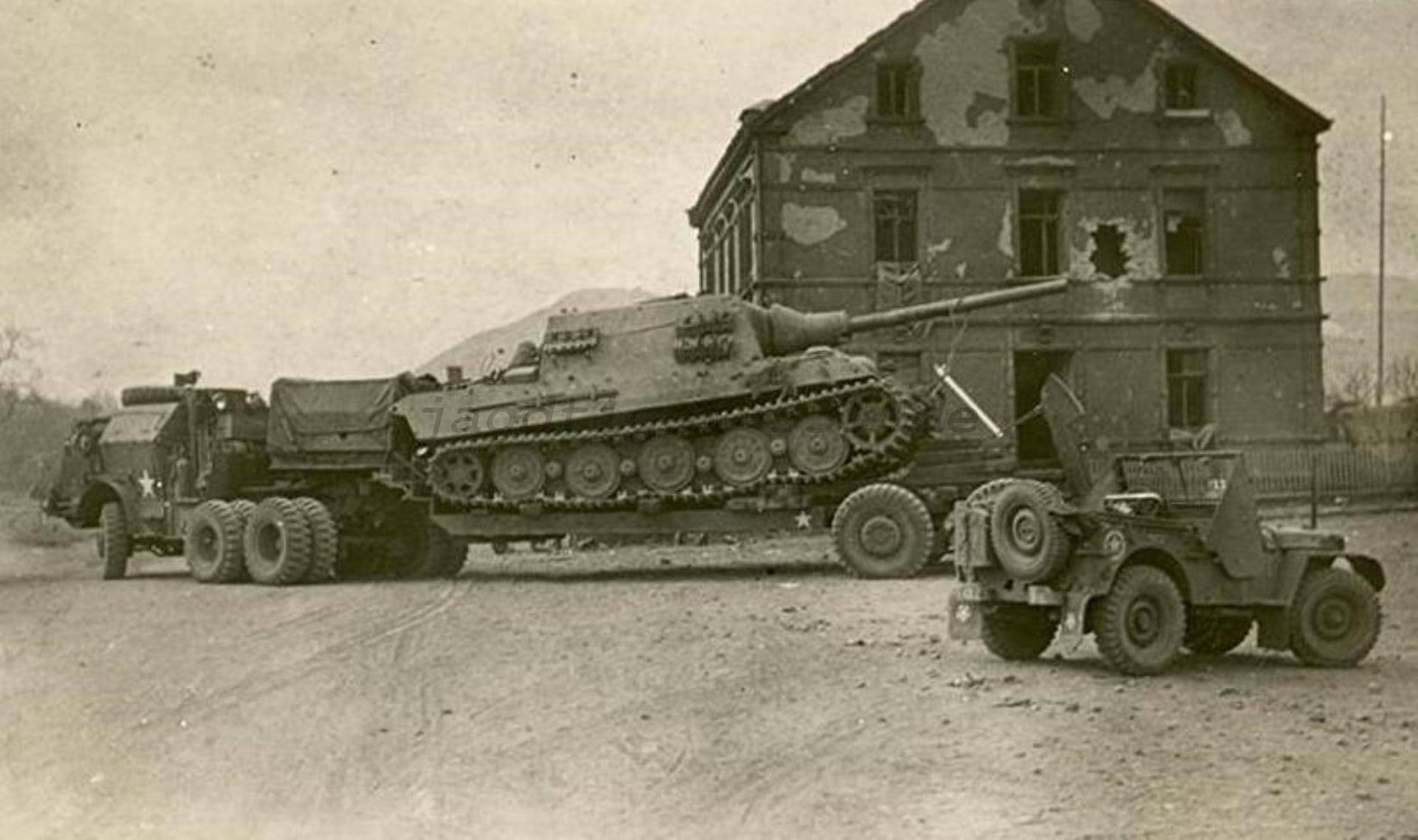
In subsequent fighting, 331 receives six frontal hits without penetration of the armor. The rearward position of the gun barrel is interpreted as evidence that the crew drained oil from the recoil brake and fired a final shot to disable the gun. A hit on the left drive sprocket immobilizes the vehicle, which eventually stands across the street. The crew abandons 331 and escapes. The existing reconstruction gives 18:00 as the time Neustadt was captured; the precise chronology remains to be verified. According to Münch, the battalion as a whole reported 25 American tanks destroyed between Neustadt and Ludwigshafen. At Böhl, he records six tanks destroyed by Lieutenant Feineisen and three by Unteroffizier Hagelstein, as well as two half-tracks destroyed by Unteroffizier Kohns. At Schifferstadt, two half-tracks are reported destroyed and two tanks severely damaged. These reports should not be regarded as independently confirmed losses. No reliable figure for tanks destroyed in Neustadt alone or by Jagdtiger 331 can be derived from them.

Withdrawal of the Battle Group
The crew withdraws towards Zeiskam with half-tracks and Jagdtiger 234. During fighting at a railway crossing, 234 is hit on the right running gear and is disabled. Göggerle’s battle group retreats via Iggelheim and Dudenhofen and subsequently crosses the Rhine near Germersheim with remnants of the battalion. According to Münch, damaged vehicles from the Bellheim area were transported by rail across the Rhine bridge near Germersheim during the night of 22–23 March. By 24 March, the remaining vehicles of the battalion had also crossed the Rhine.
Heavy Anti-Tank Battalion 653 in Spring 1945
Jagdtiger 331 belonged to the 3rd Platoon of the 3rd Company. The following organizational chart shows its place within the battalion under Major Grillenberger. In the original chart, the 3rd Company is listed under First Lieutenant Kretschmer.